Project II of VII Studio website, 2026
SourceCode
Live at sourcecode.mt
The studio's own website: editorial type, coded demos, and an enquiry and booking flow that tells the truth when something fails.
- Role
- Product design and design engineering
- Timeline
- 2026 to now
- Scope
- Identity, front end, enquiries, booking, release
- Platform
- Responsive web
- Team
- Founding team
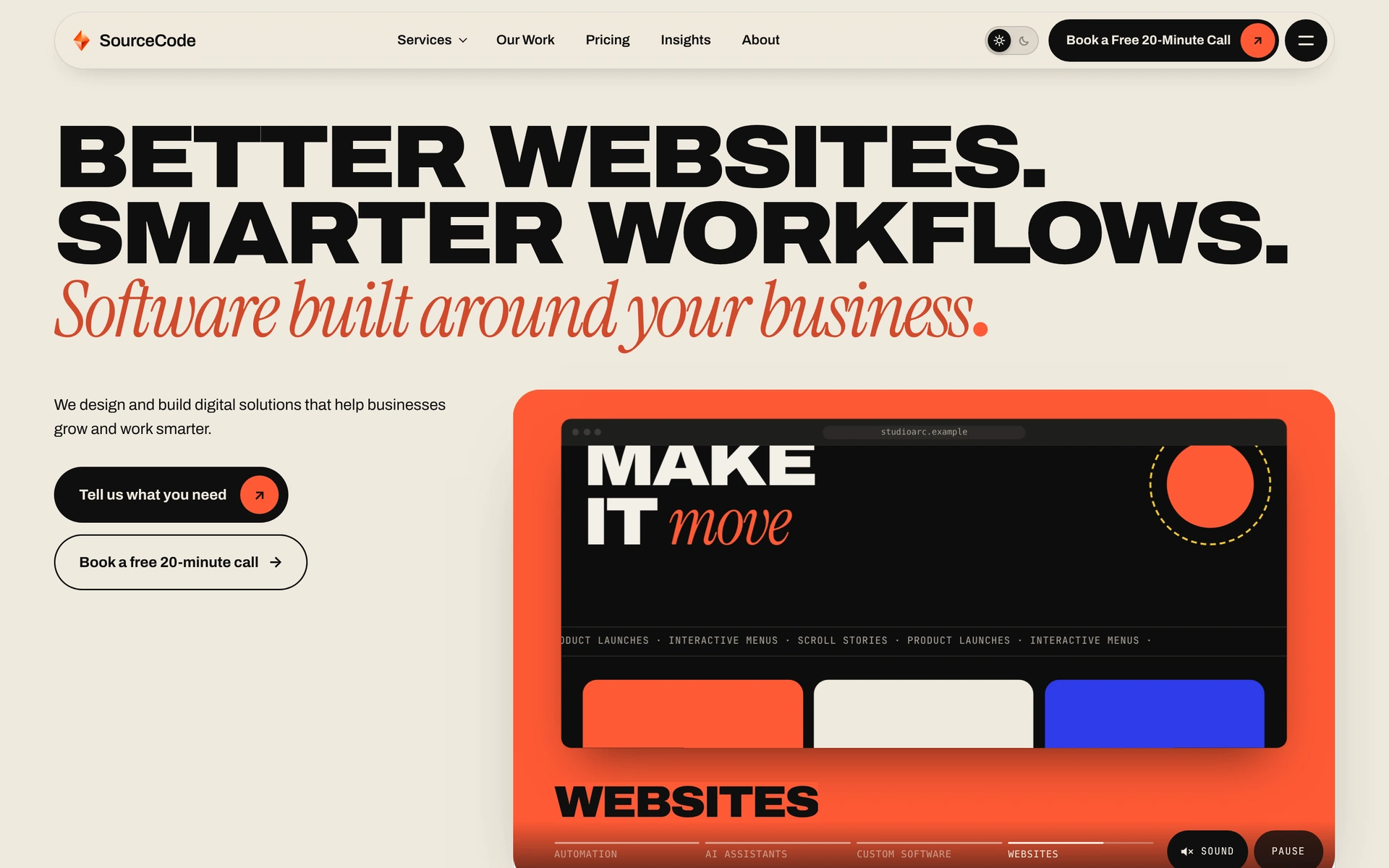
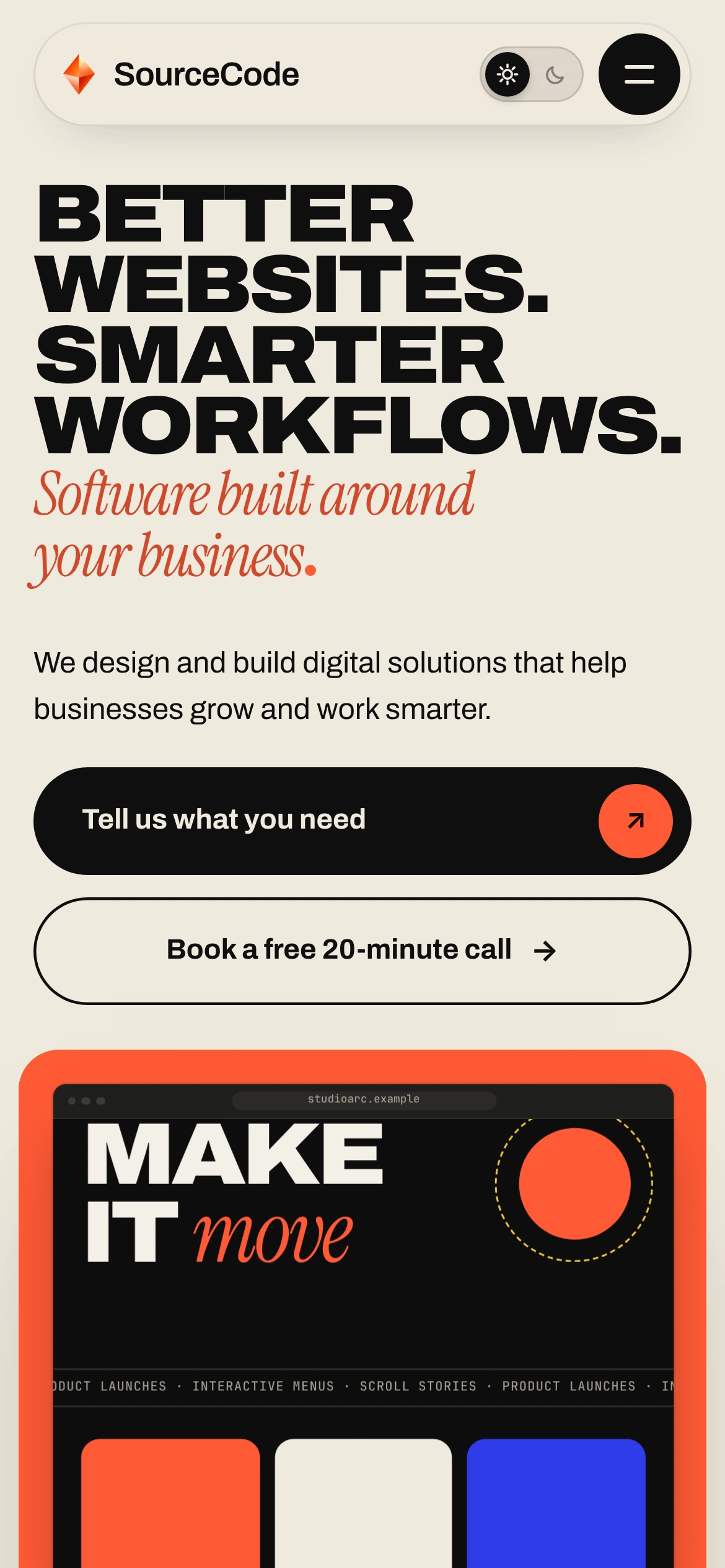
Better websites. Smarter workflows. Software built around your business.
That is the headline on sourcecode.mt. My job was the page under it. It had to read well, move for a reason, and turn a visitor into an enquiry or a booked call without ever showing a thank-you it could not back up.
A studio site that has to do the selling
SourceCode is an AI design and code studio in Malta. The site explains three services (websites, automation and AI assistants, custom software), shows them as working demos, and takes enquiries and call bookings.
The current version, V3, started in October 2026 as a new visual direction. It reuses what the first site knew about the business and none of the second site's code. When it started, the contact page had a booking card connected to nothing and a mailto link. There was no form, no server handler and nowhere for a lead to land.
It is one Next.js 16 App Router app: React 19, TypeScript, plain CSS custom properties, GSAP in small client islands, hosted on Hostinger's Node.js hosting.
- Status
- Live at sourcecode.mt
- Stack
- Next.js 16 · React 19 · TypeScript · GSAP 3
- Hosting
- Hostinger Node.js, Node 22
- Data
- Mailbox + Google Calendar. No database
What I do on it
- Design
- Identity, layout, motion, responsive behaviour
- Build
- Next.js front end, enquiry and booking flows, tests
- Release
- Staging, release archives, checks on the live domain
- Method
- Codex and Claude Code, from written briefs
I work on this with AI coding agents. The repo holds what they work from: an agent brief with twelve rules, six short project skills (source audit, conversion design, motion storytelling, SEO content, visual QA, launch guard) and a knowledge graph of decisions anchored to the code with comments.
Copy, claims and releases need a founder's approval. Nothing is pushed or deployed without one.
What shaped it
- 01
No invented claims
No made-up clients, testimonials, prices or results anywhere on the site. Demos are labelled as illustrative. Selected work says who built each project and that some of it predates the studio.
- 02
No database, no new paid services
The studio already had a mailbox and a Google calendar. Leads and bookings had to live there.
- 03
Readable without the motion
The page has to work with JavaScript off, with reduced motion, by keyboard and by touch, in light and dark, with visible focus and 44px targets.
- 04
Reviewed before it is public
New pages ship behind an approval flag. A review build shows them. Production answers 404 until someone has signed them off.
How it came together
- 01 · Three directions, one chosen
I built three visual directions on the same real content: Editorial, Signal and Kinetic. Each had a hero, a hero film and a second section. Kinetic was chosen and became the homepage.
- 02 · The pages that sell
Service pages, pricing, selected work, three industries and three workflow demos. Copy that grows lives in typed data modules, so adding an item is a data edit.
- 03 · Enquiries and booking
One enquiry form, a slot picker on Google Calendar and a page to reschedule or cancel. Provider failures were tested against mocks before any real booking was made.
- 04 · A shorter homepage
Visible homepage copy went from 731 words to 251. The detail moved to the service pages. The demos stayed.
- 05 · A campaign page
The website offer page was reviewed on a separate staging site that cannot be indexed, book a call or send mail, then released on 31 October 2026. Each phase ended with a written report of what was checked and what was not.
Decisions
- Decision 01
- Constraint
- A lead needs a durable record. The studio did not want a lead database or another paid service to hold it.
- Decision
- Use the business mailbox as the record store. Each enquiry is saved as a JSON message in its own IMAP folder, and creating that folder is the write-once claim. The form shows success only after the record is confirmed.
- Result
- A double click or a retry maps to one lead. A missing mailbox returns an error, never a false thank-you. The cost is operational: folders and quota need watching, and an uncertain send waits for a person. The offer page's counters got a small JSON ledger of their own, because counters need a transaction and a mailbox cannot give one.
- Decision 02
- Constraint
- Google Calendar's free/busy answer is not a lock. Two visitors can be shown the same slot at the same moment.
- Decision
- Claim, then book. One exclusive claim per slot goes into the mailbox first. Only then does the server create the Calendar event with its Meet link, and it confirms only when Google returns that event.
- Result
- The page says so in its own copy: your booking is confirmed only after Google Calendar accepts the event. If the calendar cannot be reached, the card falls back to Request a Call, a preferred time that someone confirms by hand. One gap is left and written down: an edit made directly in the calendar between the last check and the insert can still collide.
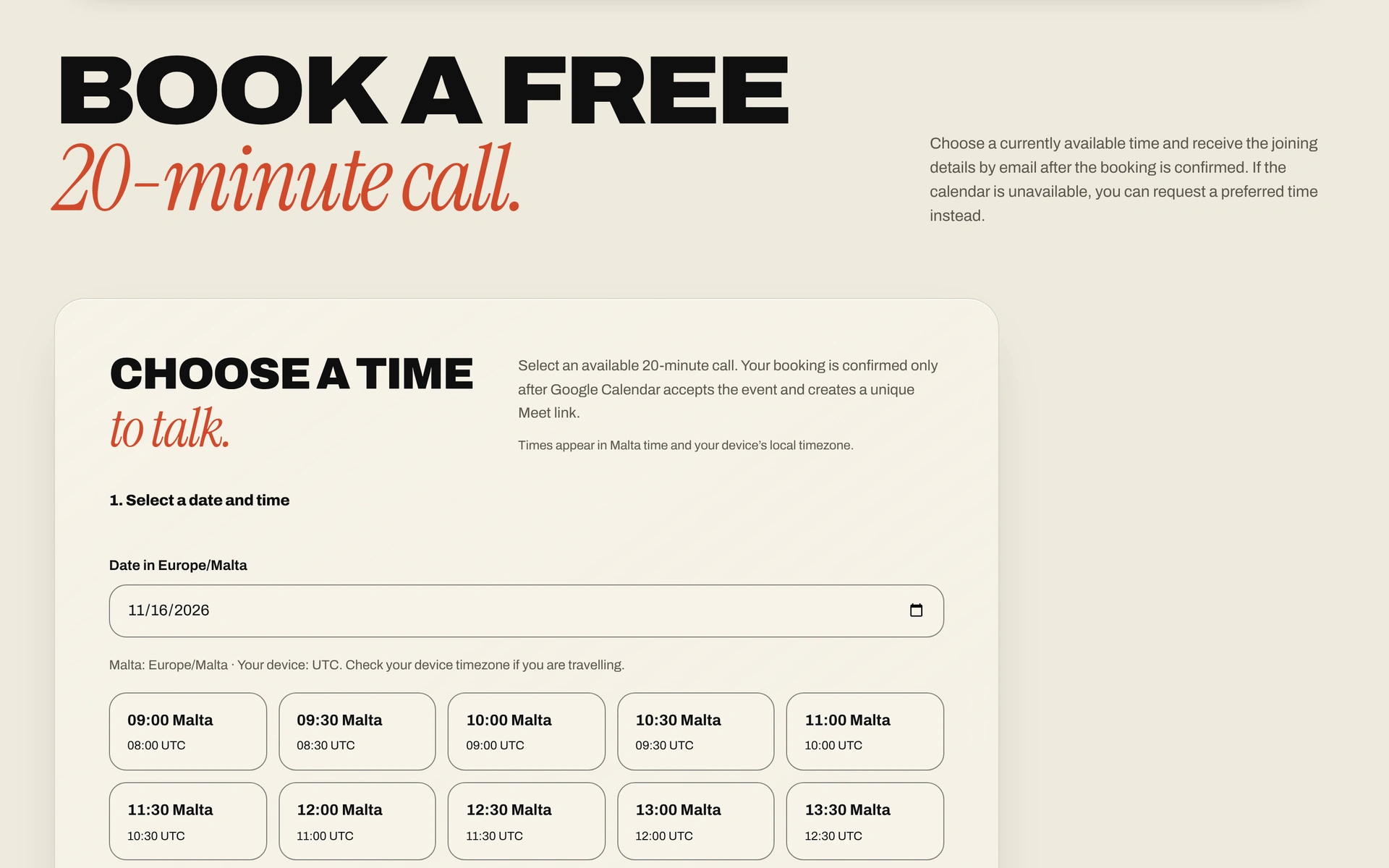
Live slots on the contact page, in Malta time and the visitor's own. - Decision 03
- Constraint
- Heavy type and scroll motion, on a page that still has to read with JavaScript off or motion reduced.
- Decision
- The server HTML is the finished composition. Effects only animate from a state, one primary effect per section. GSAP and ScrollTrigger are imported on demand, after the fonts have loaded and the text has painted, and not at all under reduced motion.
- Result
- If the motion never runs, nothing is missing. Headings already on screen are left alone after hydration, so they don't hide and replay. Navigation is native details elements. Every timeline, trigger and listener is cleaned up on unmount.
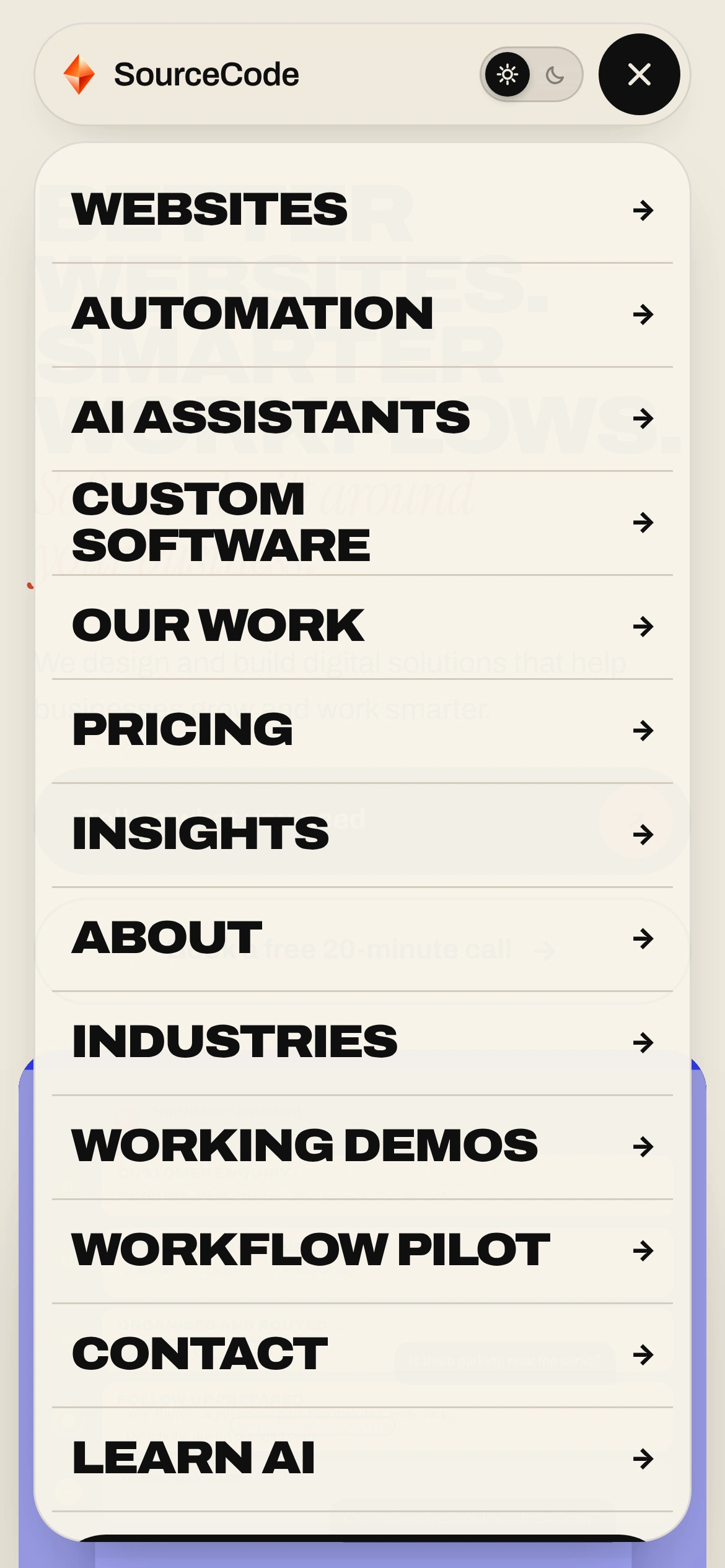
The menu is a native details element. It opens with JavaScript off. - Decision 04
- Constraint
- Eight chapters, several with live demos. An early preview measured 13 to 18 seconds to largest paint on a throttled phone, most of it one long layout before first paint.
- Decision
- Six chapters below the hero use content-visibility: auto with measured heights, and each demo mounts only when its chapter is near.
- Result
- Paint time came back level with the live site of the time. The trade-off showed up next: a skipped chapter paints as bare background, so a fast fling showed blank screens. Now the first scroll releases every chapter in page order, one per idle slot. First paint is unchanged and the blanks are gone.
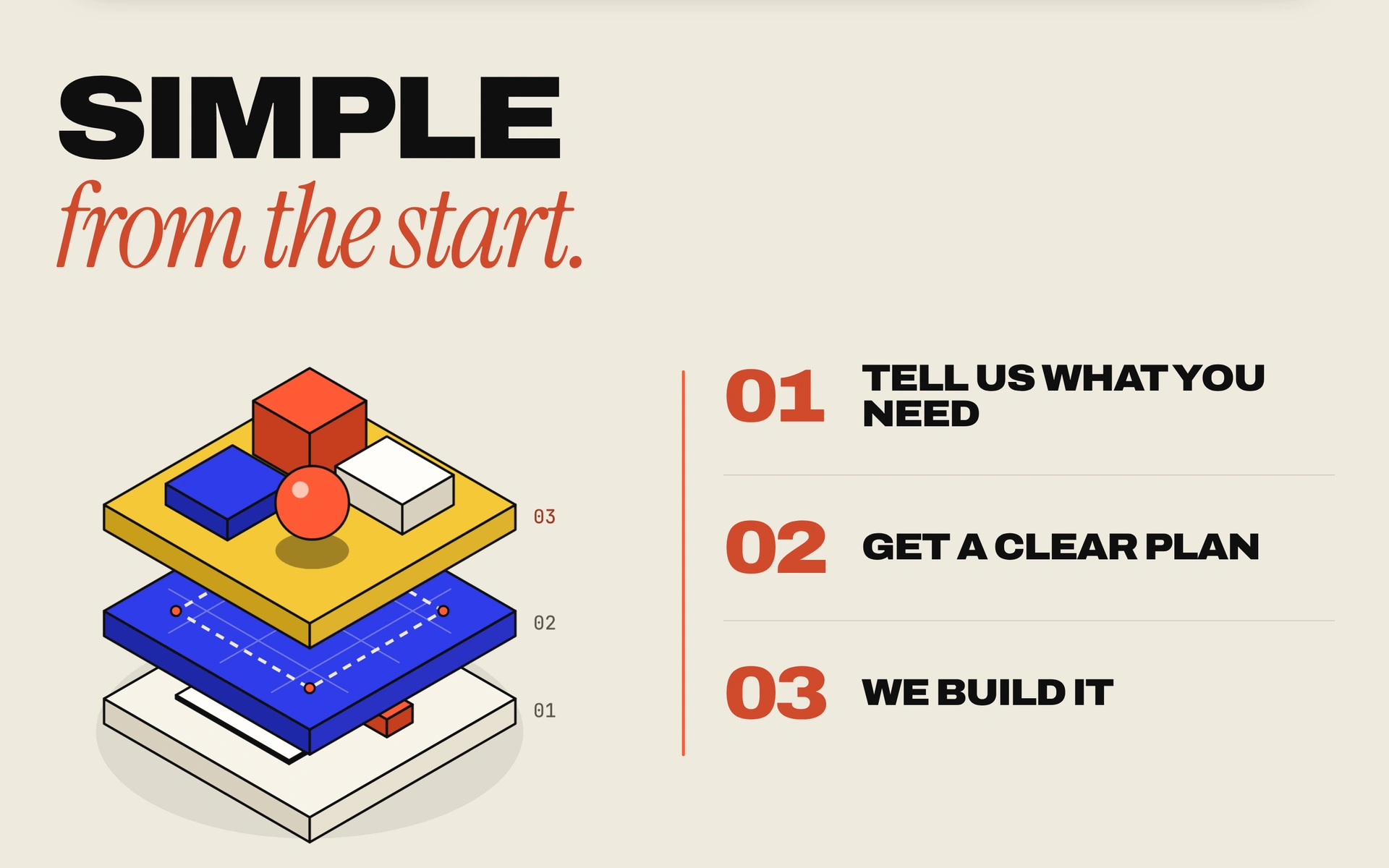
How it works: one of the six chapters the browser skips until it is near.
On the page
Motion with a job
- 01 / 04
A showreel made of code
The hero plays four coded scenes, one per service. It runs only while it is on screen and the tab is visible. Pause is always there. Sound is off until someone turns it on.
Hero: the showreel on its Websites scene. - 02 / 04
Two tiles that carry intent
Have a website and Need a website open the same service page. The difference travels as the existing service value in the link, so a redesign lead is recorded as someone with a site already. No new form, no new parameter.
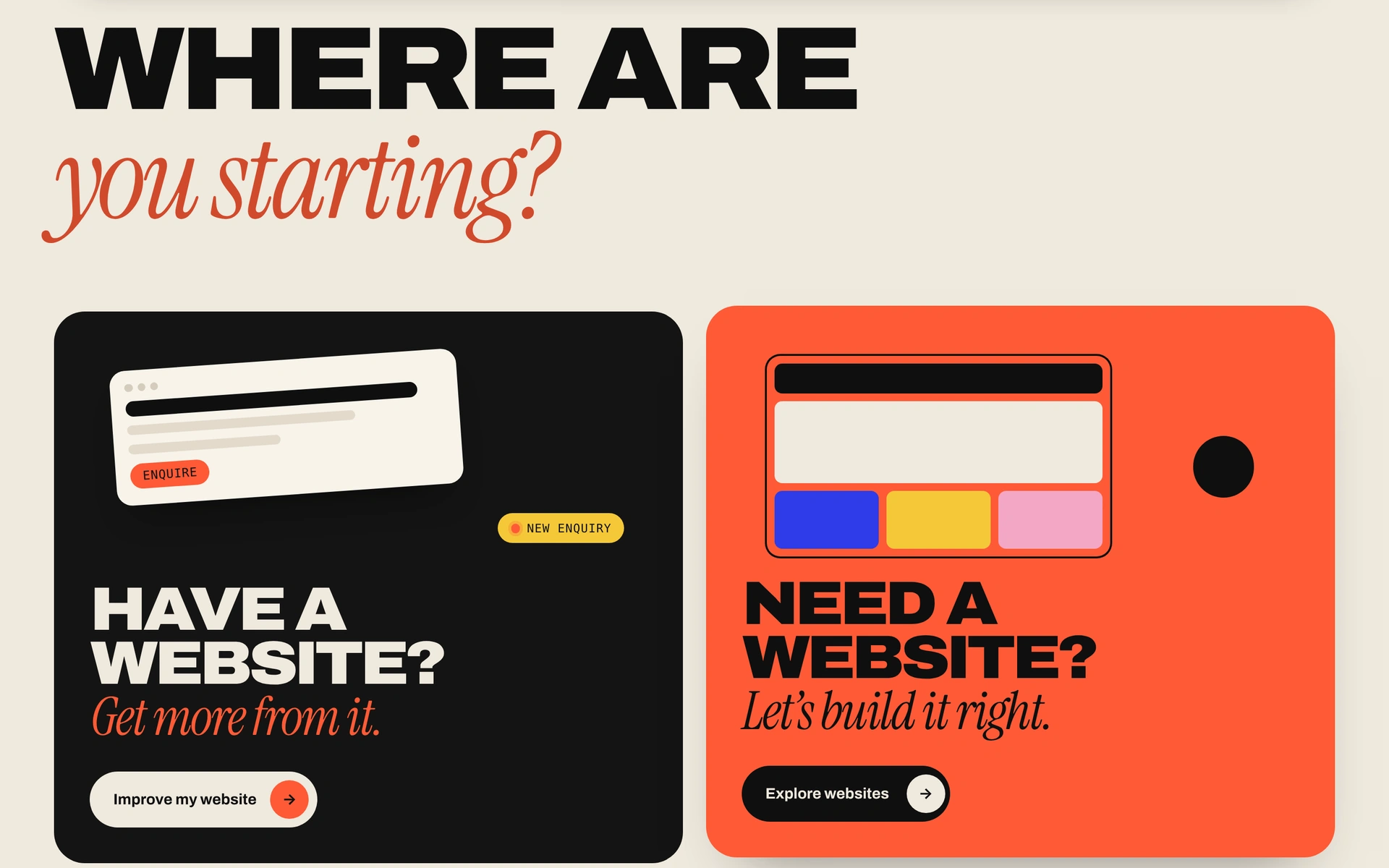
Where are you starting? - 03 / 04
Demos, not pictures of demos
Each service has one working illustration. The workflow and the AI assistant share a stage with tabs and take turns. Every stage says Illustrative example, because none of it is client data.
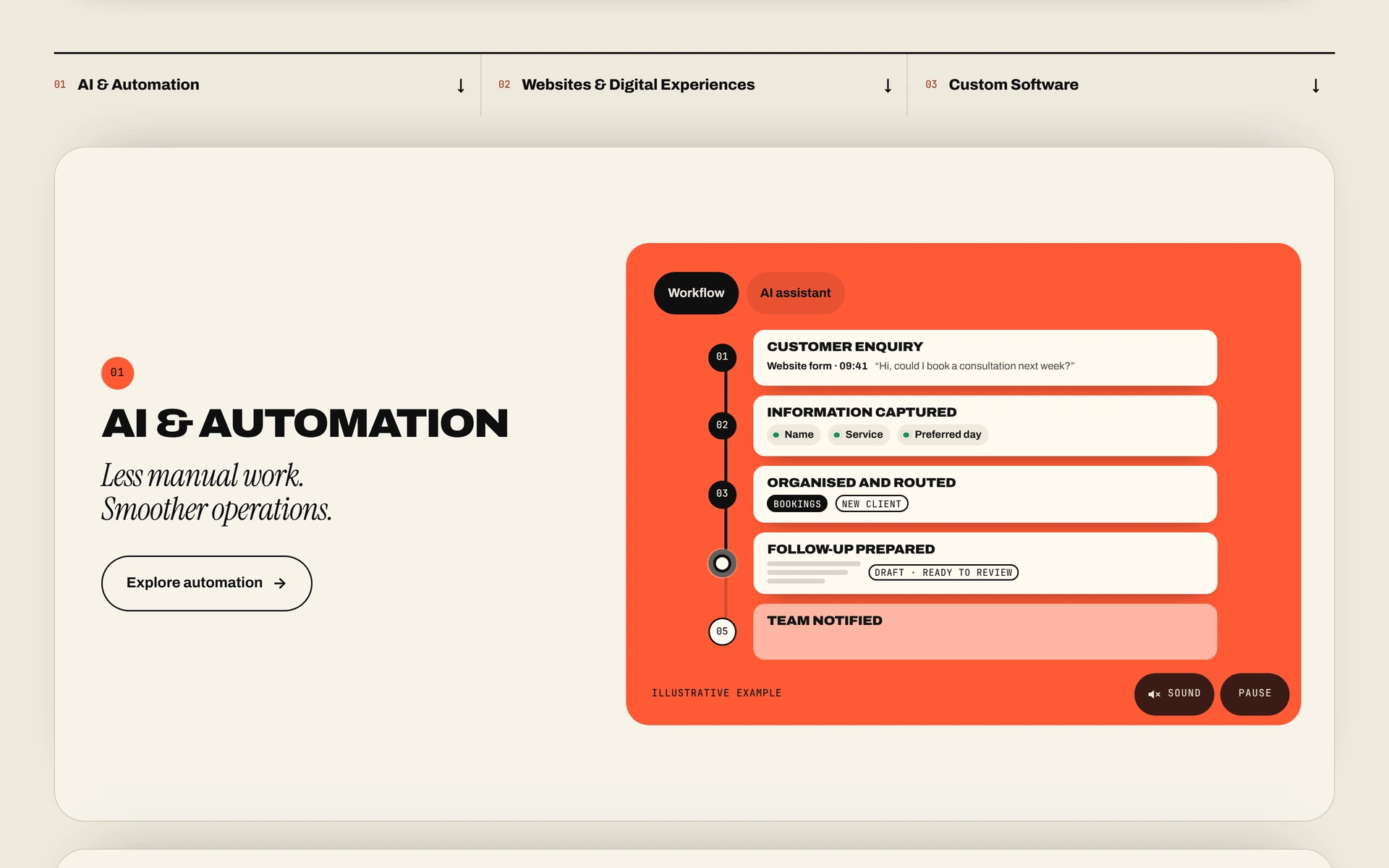
AI & Automation: the workflow demo mid-run. - 04 / 04
A 3D diamond with no WebGL
The offer page has a ten-second tapping game. The diamond is the brand mark as SVG facets, each mapped by one affine transform onto a projected solid and driven by springs. Three.js is not installed. The server decides every result. Keyboard and screen reader play the same round, and reduced motion keeps the game and drops the particles.
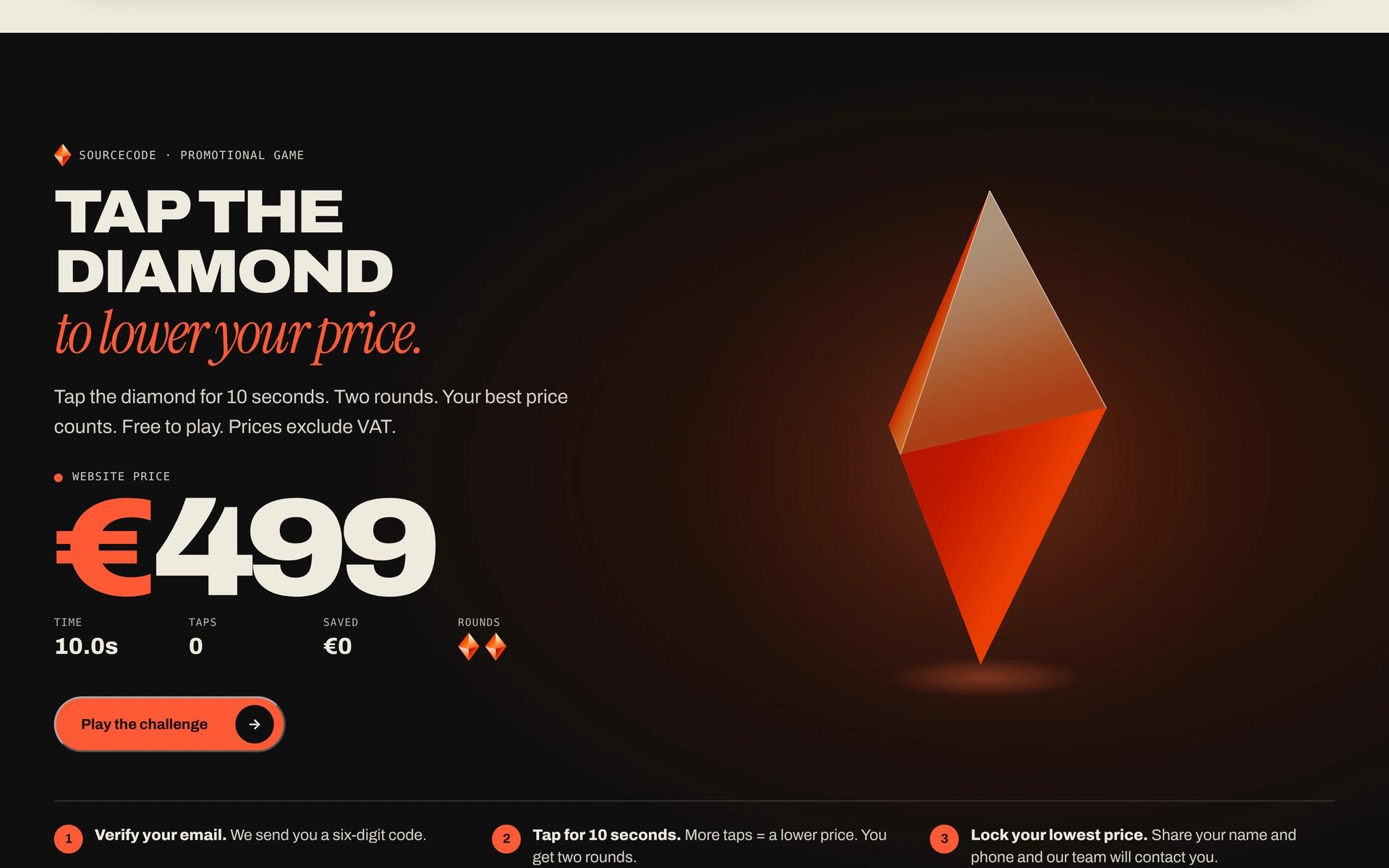
Tap the Diamond on the website offer page.
Kinetic Editorial
Heavy uppercase Archivo, an Instrument Serif italic line as the counterpoint, JetBrains Mono for labels. Cream and ink swap roles in dark mode. Blue, pink and yellow stay fixed for the demo stages.
An earlier build let visitors pick from six accents. The picker was removed in October 2026 and vermilion became the only one. The design record in the repo is a scan of the shipped CSS. The CSS stays the authority.
- Vermilion#FF5A36
- Cream#EFE9DE
- Ink#0F0F0F
- Blue#2F3BE8
- Pink#F4A7C6
- Yellow#F5C838
- Display: Archivo900 · clamp(2.55rem, 8.5vw, 11.6rem) / 0.86 · uppercase
- Counterpoint: Instrument Serif italic400 · clamp(2.8rem, 8.4vw, 11.2rem) / 1
- Body: Archivo400 · clamp(1.02rem, 1.25vw, 1.2rem) / 1.55
- Label: JetBrains Mono500 · 0.66rem · 0.08em tracking · uppercase
On a phone
The same server HTML, restacked. Grids stack at 900px and fields go to one column at 620px. Body copy is never shrunk to keep a desktop layout.
Home: the headline keeps its weight. Menu: the capsule's links, in the same order. 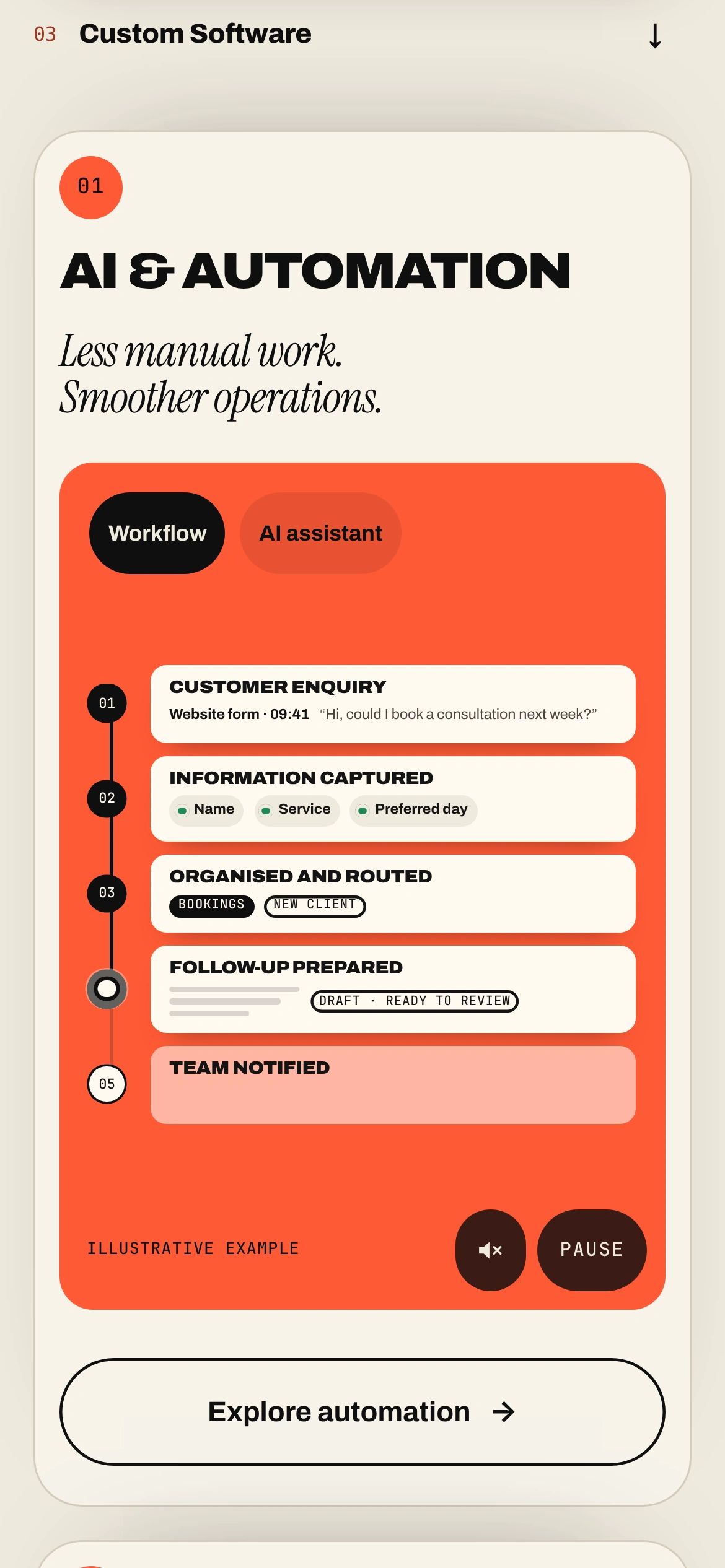
The workflow demo at phone width. 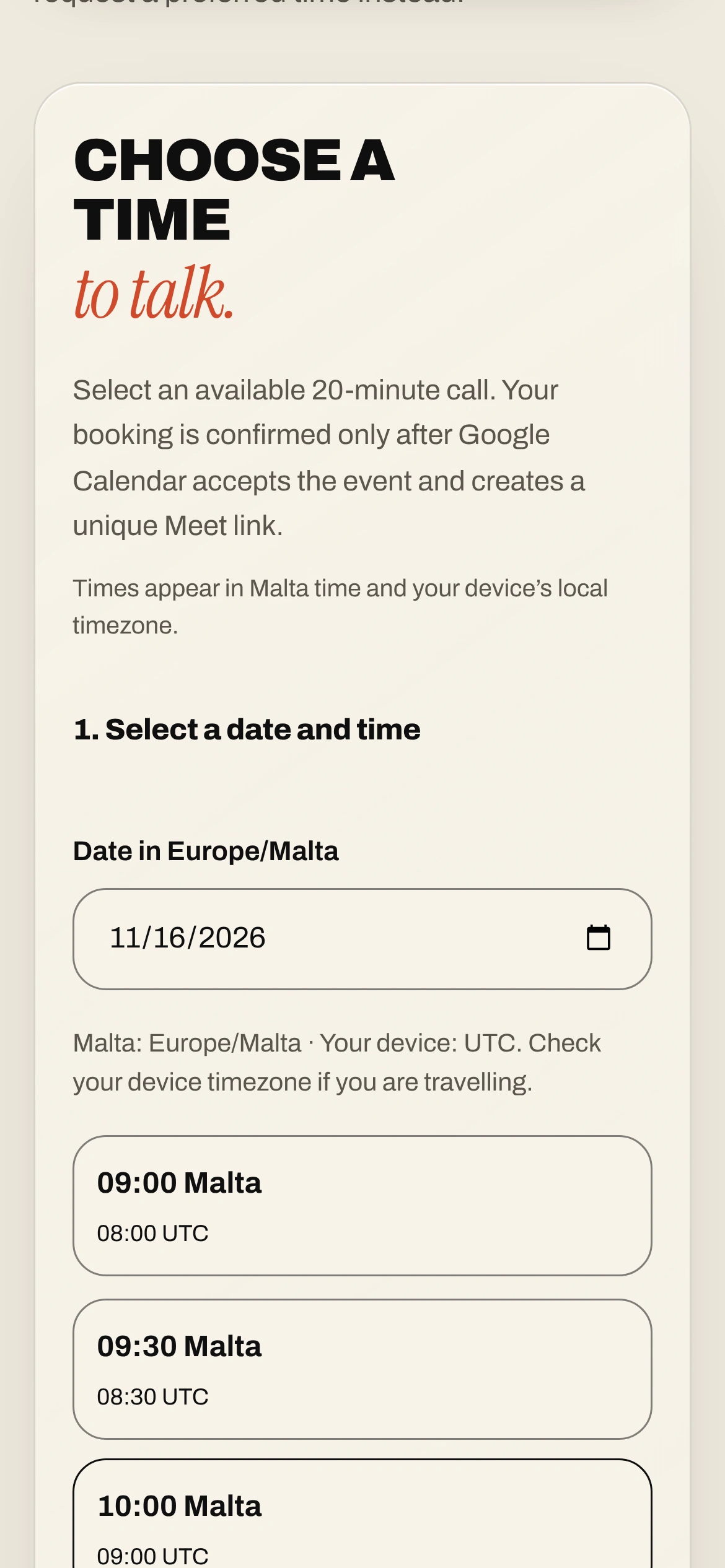
Booking: date first, then the slots.
What is live and what is not
Published on sourcecode.mt
- Homepage, four service pages, pricing, selected work, studio and contact
- Three industry pages, three workflow demos and the Workflow Pilot page
- Enquiry form, Google Calendar booking and the manage-booking page
- The website offer page with Tap the Diamond
- Privacy, terms and cookies, with analytics off until a visitor opts in
In the repo, not public
- The three early visual directions. Review builds only; Production answers 404
- SourceCode V1 and V2. V1 is kept as a content reference. V2 is not in this codebase
- A further reward tier in the offer game, built and switched off until it is approved
- Three draft Insights guides, and a research pipeline that drafts and never publishes
- A Learn AI page, retired when courses moved to a separate Academy site
Where it is now
The site is live at sourcecode.mt. The latest release recorded in the repo is 31 October 2026, which added the offer page. I have no traffic or lead numbers to publish, so there are none here.
- Live at sourcecode.mt on Hostinger Node.js hosting
- Enquiries and call booking run on the studio's mailbox and Google Calendar, with no database
- One check command (typecheck, lint, 27 test files, production build) runs on every push
Reflection
What people see on this site is type and motion. Most of the engineering went into what happens after someone presses a button: where the lead is stored, what the visitor is told when a provider fails, what a retry does. The rule I kept coming back to was simple. Show an error, never a false success.
One thing is not done. The lab runs recorded in the repo missed the 2.5 second target for largest paint on a throttled phone. That is the next piece of work, and it gets measured before I say it is fixed.
Next project, III iGaming concept, 2025
VantageBet
Concept with a coded prototype
A mobile casino and sportsbook concept: 26 screens across discovery, betting, wallet, onboarding and account, in dark and light.